The first LMS built for standards-based grading.
Your gradebook shows 72%. But which standards did they master? Legacy platforms can’t tell you.
Built from scratch on a mastery data model — not percentage grades with AI bolted on.
Your gradebook is hiding the real story.
A student gets 72% on a fractions test. What does that tell you? Not which standards they’ve mastered. Not which prerequisite skills are missing. Not what to do next.
Percentage-based gradebooks flatten learning into a single number. Teachers are left guessing where students are stuck — and students fall behind before anyone notices.
This isn’t a feature gap. It’s an architecture problem. Legacy platforms store grades as percentages because they were built for attendance and compliance, not learning. You can’t patch mastery tracking onto a system designed for seat time.
What changes when your data model starts with standards.
See the product
Standards-based grading that teachers can actually see
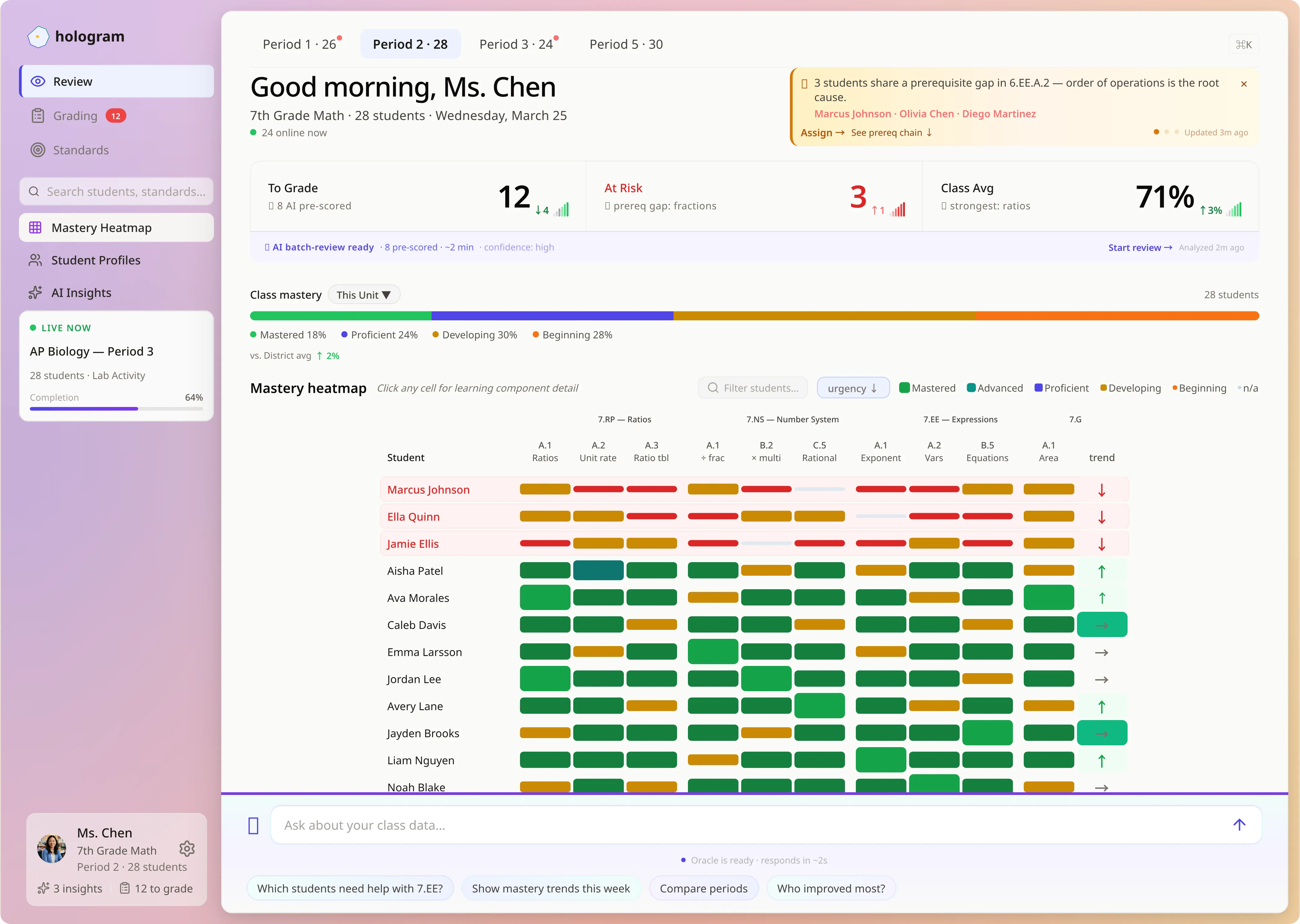
Hologram Oracle — Every student × every standard, with AI-identified prerequisite gaps
One system, three perspectives
Students, teachers, and administrators —
all looking at the same living data
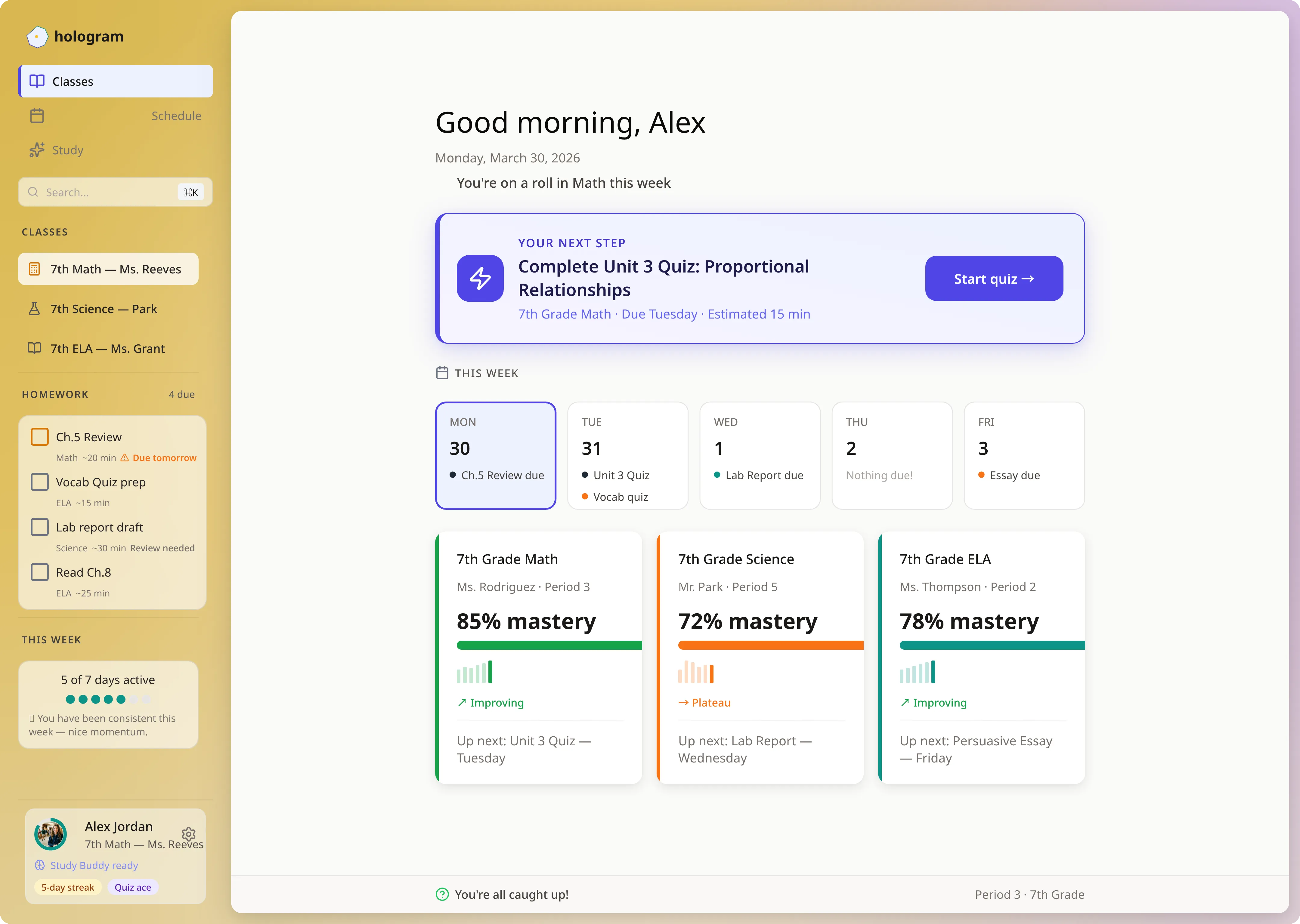
Student Dashboard
Mastery trajectories, AI recommendations, and clear next steps
Teacher Oracle
Student × standard mastery grid with AI-identified gaps
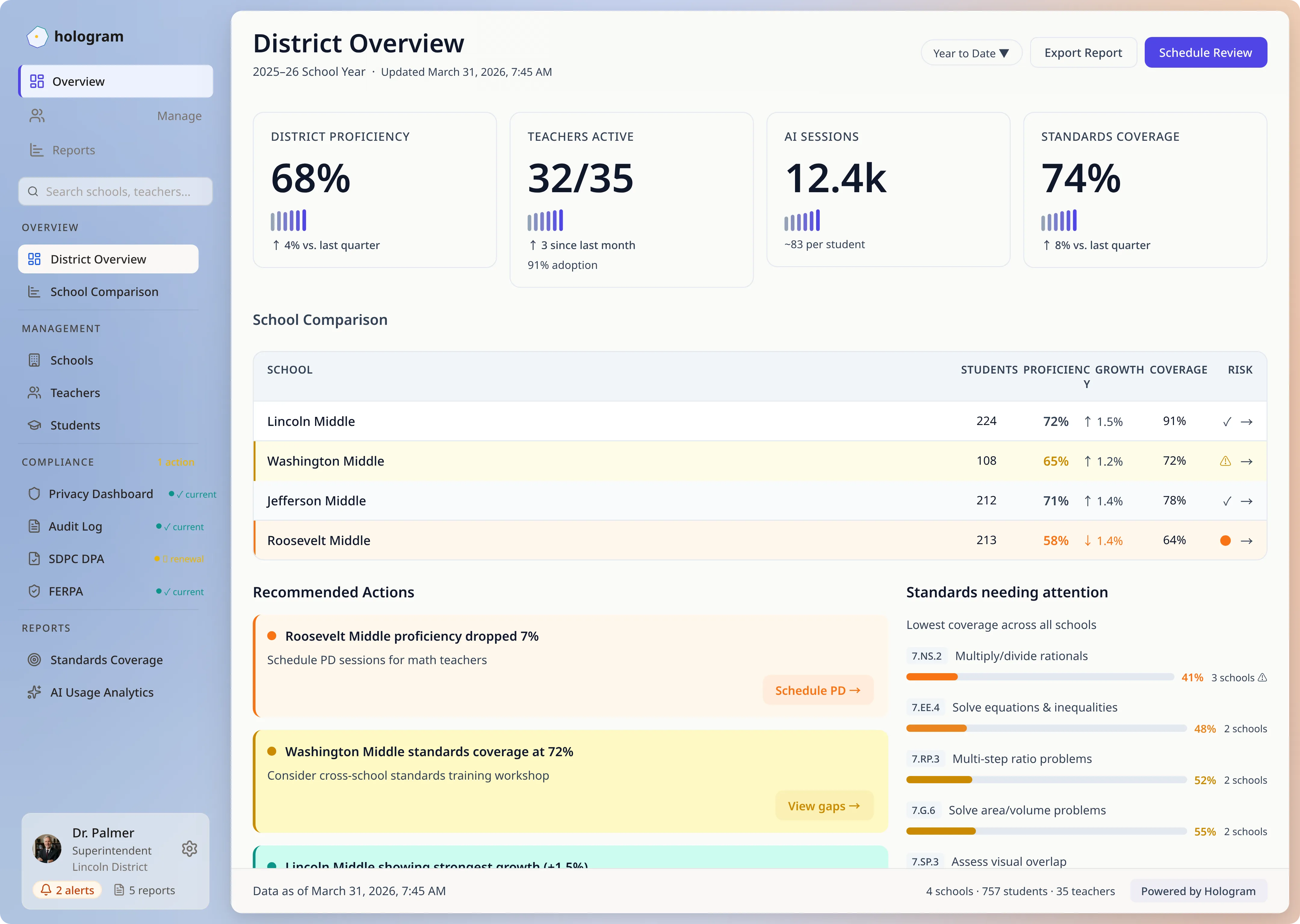
District Overview
School-level analytics, compliance status, and AI-powered actions
How it works
AI that teaches, not just tracks
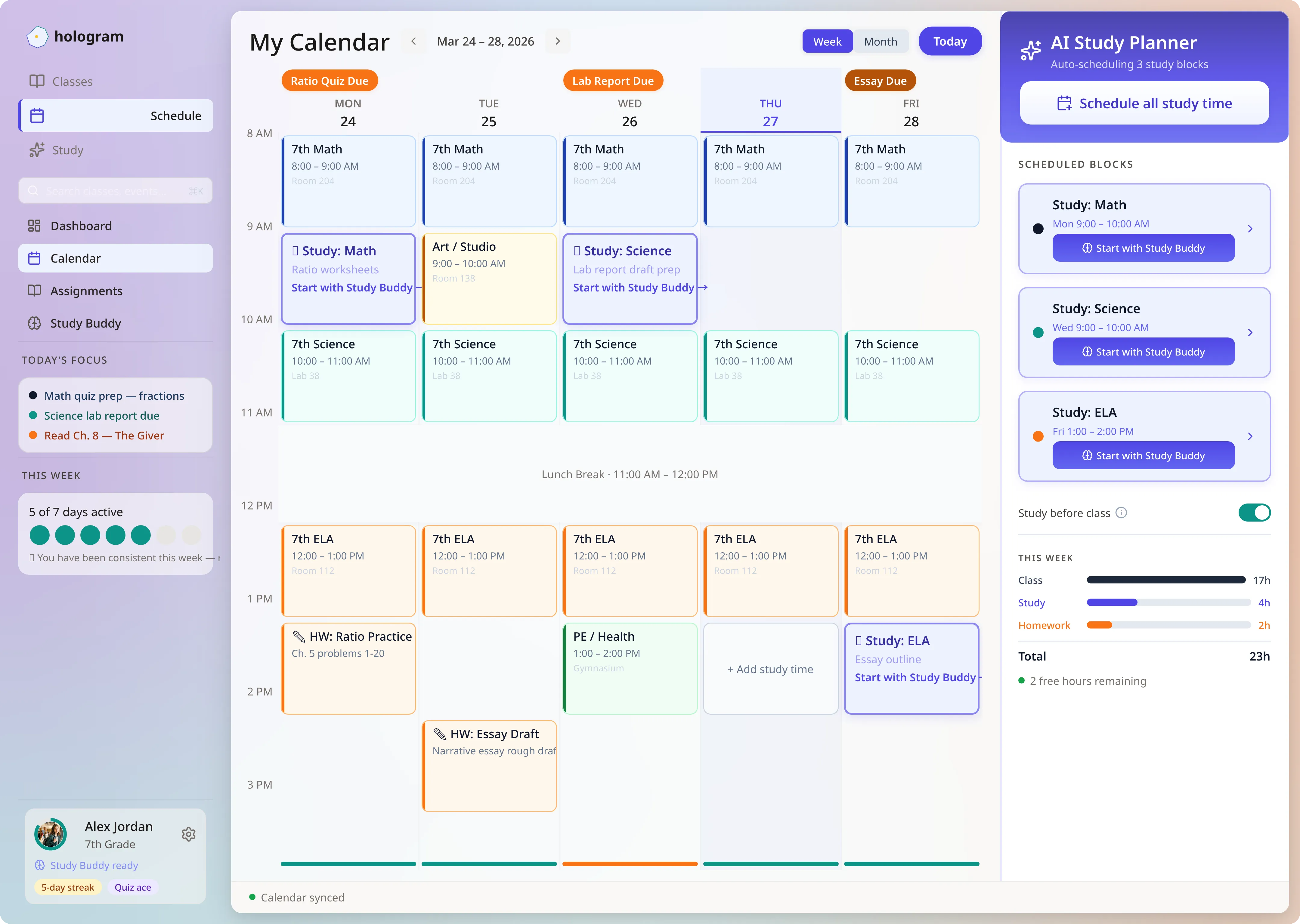
AI finds time in the schedule and fills it with what matters
The calendar isn’t static — it reacts. When a student finishes a quiz, the afternoon study blocks adapt. AI identifies gaps between classes and suggests targeted practice sessions based on prerequisite chains and mastery trajectories.
Auto-scheduling 3 study blocks based on mastery gaps and free time
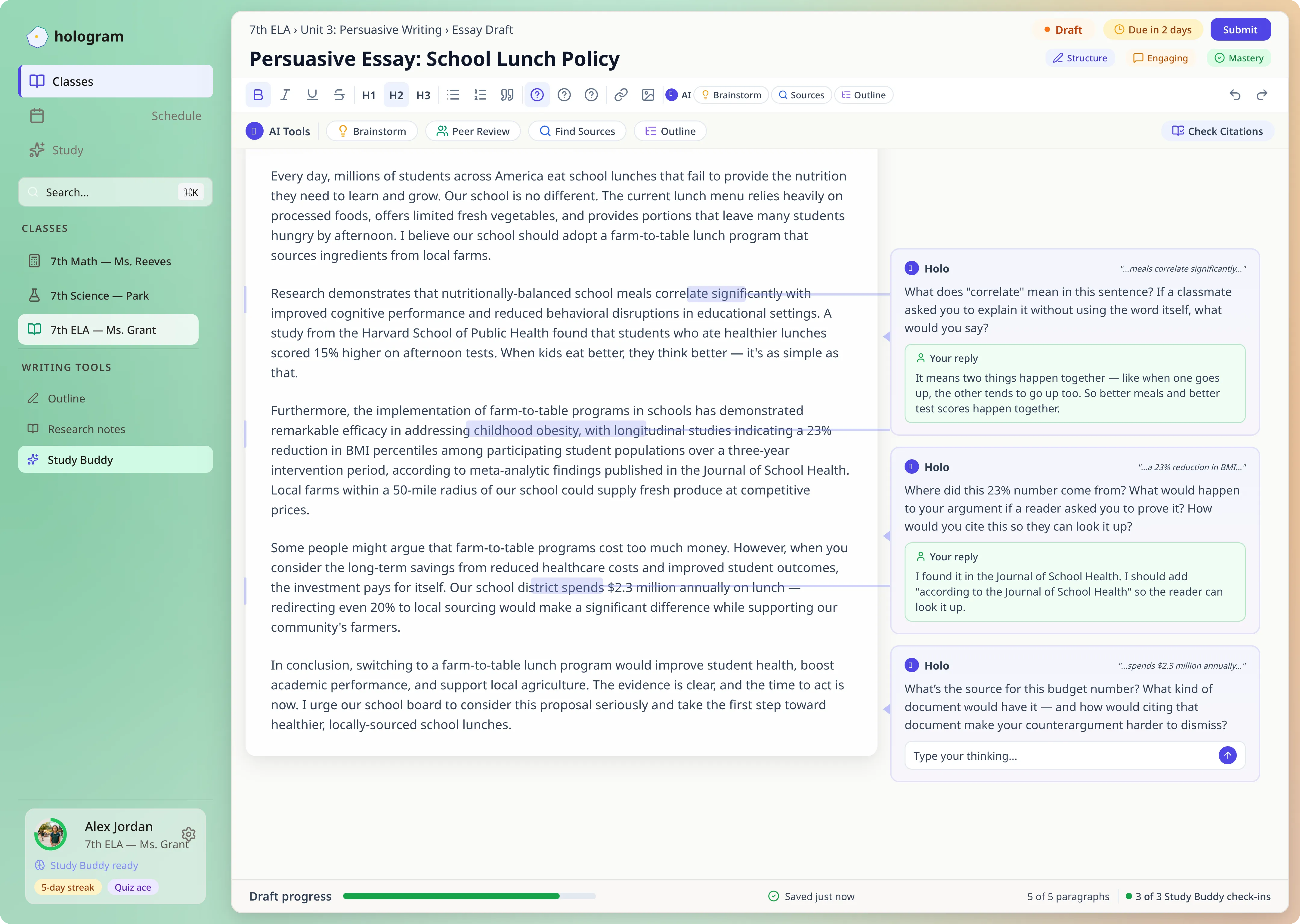
AI tutoring inside the assignment — Socratic, never corrective
Holo reads alongside the student and asks questions that make them think deeper. ‘What does correlate mean in this sentence?’ ‘Where did this 23% number come from?’ Every question maps to a rubric criterion. The student learns to write better by thinking, not by being told.
3 of 3 Study Buddy check-ins complete · Draft progress tracking
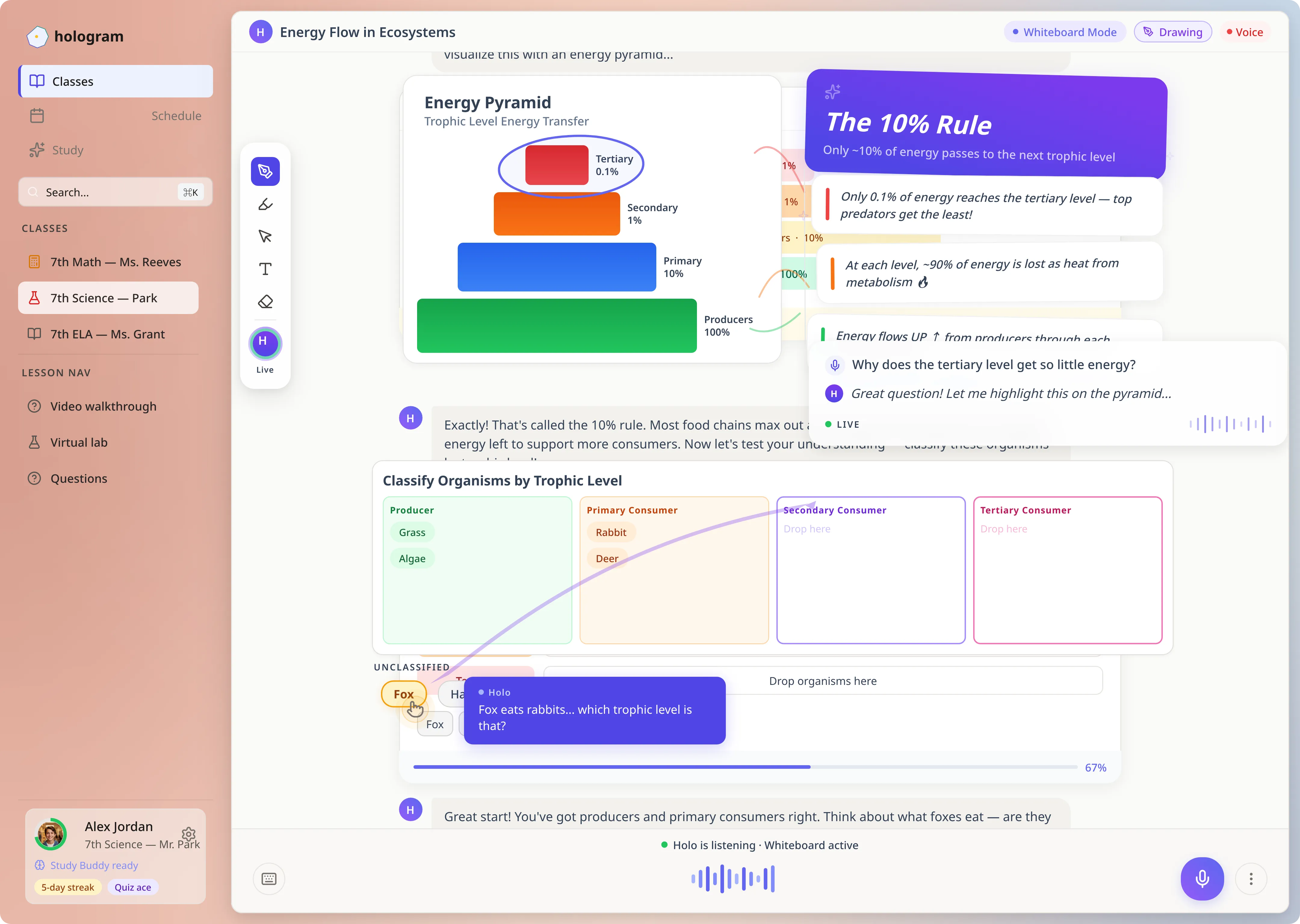
Voice-enabled AI tutor inside interactive lessons
Students ask ‘Why does the tertiary level get so little energy?’ and Holo highlights the pyramid, explains the 10% rule, and guides them through a classification activity. The AI is inside the lesson — not next to it. It references the content, nudges when students are stuck, and adapts in real time.
Holo is listening · Whiteboard active · 67% lesson progress
District leaders see what matters before it becomes a problem
Four schools, 757 students, 35 teachers — all in one view. AI surfaces anomalies (‘Roosevelt Middle proficiency dropped 7%’), recommends actions (‘Schedule PD sessions’), and tracks standards coverage gaps across the district. Compliance status is always visible, never buried.
4 schools · 757 students · Data as of March 31, 2026 7:45 AM
Ready to see this in your classroom?
Join the Pilot →Research-Backed
Built on Evidence, Not Hype.
Every capability in Hologram is grounded in peer-reviewed research on AI-assisted learning, standards-based grading, and cognitive science. These are the evidence foundations for our approach — our own efficacy data will come from the Fall 2026 pilot.
Students using AI tutoring scored roughly a half letter grade higher in algebra. Hologram’s Socratic tutor is built on this same approach.
Standards-based grading consistently improves student outcomes. This meta-analysis covers the research Hologram’s grading model is built on.
States are actively adopting competency-based education policies. The shift from seat time to mastery is accelerating — and legacy platforms can’t keep up.
"The 'knowing-doing gap' in standards-based grading remains wide — teachers believe in it, but lack tools that make it practical."
— Guskey & Link, 2022Common Questions
Frequently asked questions.
For Teachers
For Districts
Get early access.
You believe grades should mean something. Now you can prove it. Hologram runs alongside your existing Canvas setup — free, low-risk, and early adopters shape the product.
What you get
- Full Hologram platform for your classes
- AI-powered grading at the standard level
- Socratic tutoring for every student, 24/7
- Mastery dashboards for you and your students
- Direct line to the founder for feedback and support
- Free during the early access period
Your commitment
- Use Hologram alongside Canvas in your classroom
- Honest feedback on what works and what doesn’t
- 30 minutes of feedback over the semester
Takes less than 30 seconds · We respond within 48 hours · Your data is never sold
Why this exists.
Standards-based grading is the single most requested capability in K-12 education technology — and no major platform supports it natively. Not Canvas, not Blackboard, not Google Classroom. The reason is architectural: legacy LMS platforms store grades as percentages. You can’t build mastery tracking on a percentage data model any more than you can build Google Maps on a spreadsheet.
Hologram is built from scratch on a different foundation — a mastery data model where every student interaction maps to specific learning standards, prerequisite relationships, and cognitive science. The AI isn’t a feature bolted onto a gradebook. It’s the native intelligence layer of a system designed for learning, not administration.
I’m a solo technical founder building Hologram with AI-augmented development. If you’re an investor, educator, or researcher interested in what we’re building, I’d love to hear from you.